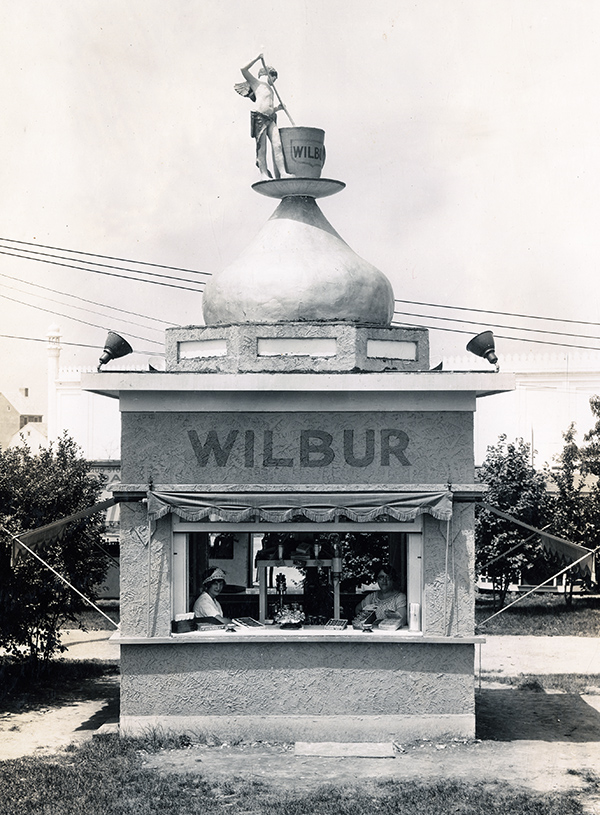
The Wilbur Cocoa Company Concession Booth at the Sesquicentennial Exhibition in South Philadelphia, 1926.
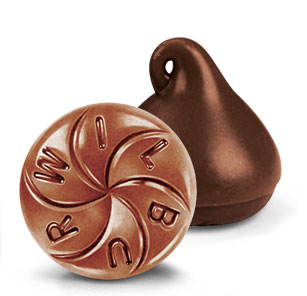
The Society Hill based H.O. Wilbur & Sons Chocolate Company started making and selling Wilbur Buds in 1894. The lookalike Hershey Kiss was first marketed in 1907. There are differences.
Unlike the Hershey Kiss, the Wilbur Bud is sold in both milk and dark chocolate. Buds are not individually wrapped. Plus, each is impressed with the molded name of its maker.
One might argue that the Kiss has long been the runaway winner in terms of candy making and marketing. But in 1926, the Bud had an innovative moment that should be remembered in another context.
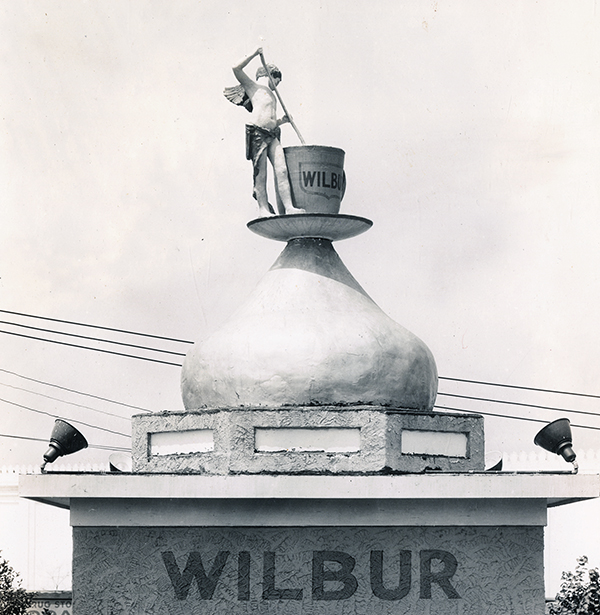
The oversized Bud atop the Wilbur concession booth at the Sesquicentennial was decades ahead of its time. a precursor to the Pop Art movement. It was akin to the even larger, 80-foot electrified model of the Liberty Bell, also prominent on the Sesquicentennial grounds.
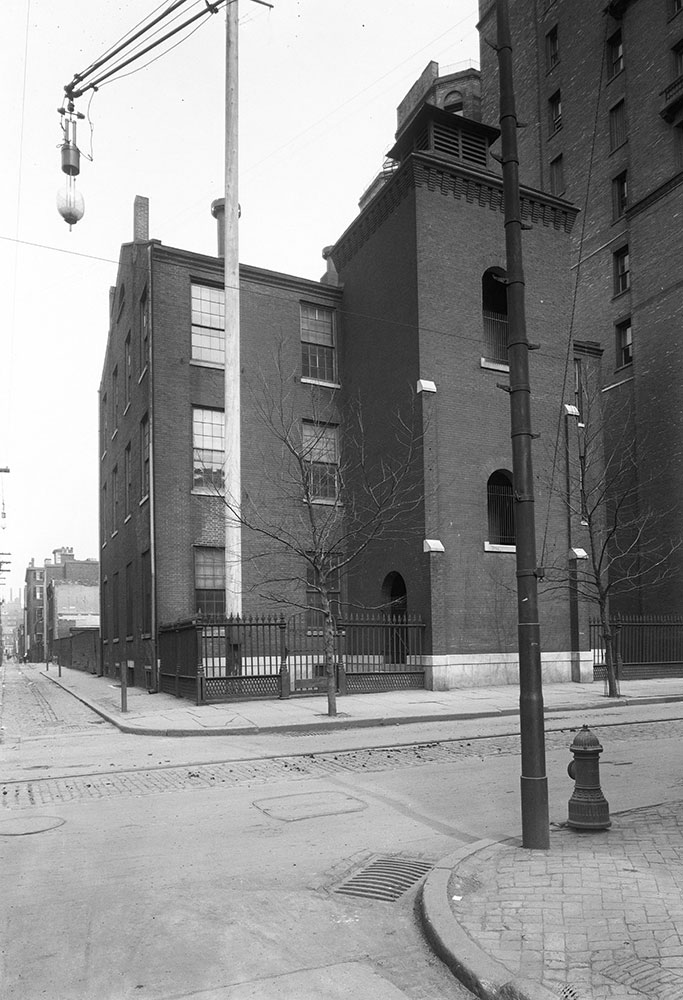
The J. Sylvester Ramsey School, Pine and Quince Streets, March 8, 1913 (a few years before it became Philadelphia’s Trade School for Girls.) (Free Library of Philadelphia, Print and Picture Collection.)
Rebuilding rendered the brick building at Pine and Quince Streets barely recognizable. But the three-story structure, once known as the J. Sylvester Ramsey School carries with it a web of worthy associations.
Those of a certain age will remember the building as Phineas Meade’s antiquarian den, an overcrowded haven for all things old, dusty and wooden. Phin, as he was known, occupied the building from 1949 until his death in 1983.
Those interested in the history of architecture would lean into the significance of the original structure built in 1850.
Students of the Seventh Ward would recall W.E.B. DuBois’ observation that the school was the largest in the ward with a “nearly all colored” student body of nearly 500.
And then there’s the story of Philadelphia’s Trade School For Girls, which occupied the building starting in 1918.
That year, something like eleven million women and girls were in the American workforce. Philadelphia’s bourgeoning industries employed about 94,000 girls between the ages of 14 and 16. Of them, 27,000 worked in the garment trades, a number that increased year to year. Four thousand of these wage-earning girls were also enrolled in the city’s schools.
And yet the city’s public schools offered little or no training relevant to their employment.
“The majority of these women were not fitted for any type of work,” declared Cleo Murtland, an authority on industrial education. Their education is “seriously lacking.”
Trade School for Girls, Pine and Quince Streets, 1920 (PhillyHistory.org)
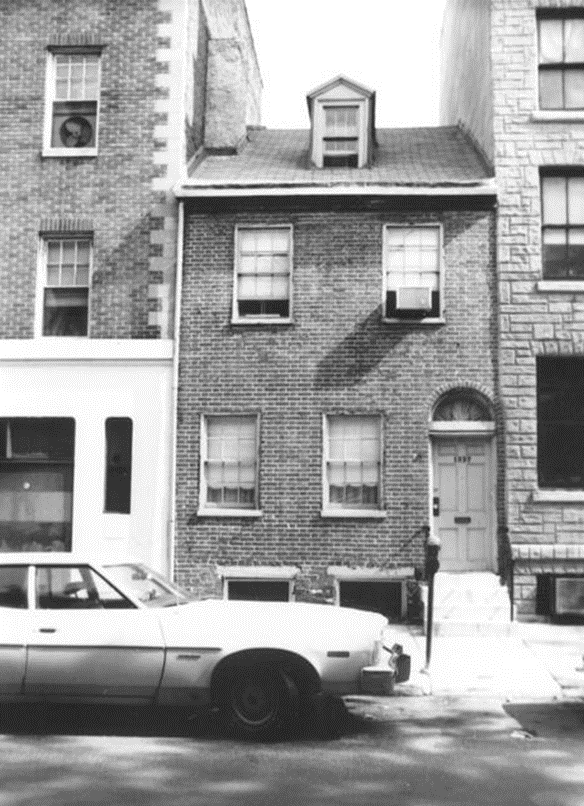
But things were about to change. A group of philanthropic reformers (all women) had taken over a rowhouse at 415 South Ninth Street (the building still stands) and established there a school that provided free instruction in “dress making, millinery, lampshade making and novelty work,” skills that would “enable the untrained girls of the city to earn a livelihood in the industrial world.”
With only 79 students, this first iteration of Philadelphia’s Trade School for Girls only scratched the surface. Then Philadelphia’s Committee on Vocational Education recruited Murtland from the Manhattan Trade School for Girls, an “experiment without precedent” (memorialized here in a short film from 1911). Murtland hit the ground running, in Philadelphia, surveying “upwards of 600 factories, where women and children are employed” and then designing an expanded vocational curriculum to be funded and operated by the School District. During its first year, according to Murtland, “educators, employers, workers, public spirited citizens, educational, civic and philanthropic organizations … [all] urged the public school authorities to recognize its place in the public school system of the city.”
Detail. Trade School for Girls, ca. 1920. Pine and Quince Streets (PhillyHistory.org)
They succeeded in getting their message across. And with funding from the city and Murtland as principal, the school took over the school building at Pine and Quince Streets.
Murtland later wrote: “Philadelphia is one of the largest industrial cities in the country, a city of varied industrial activities, the center of the knitting industry, a leading city in the manufacture of cotton and woolen woven fabrics, a shoe manufacturing center, a community with large printing establishments, extensive jewelry factories, and many other industrial interests which employ women workers.” The city “presents an extensive and varied field for the development of vocational education…”
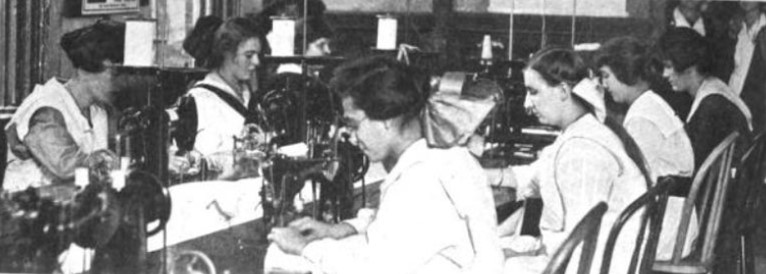
Learning Power Machine Operating at the Philadelphia Girls Trade School, in Cleo Murtland, “Pennsylvania’s First Trade School for Girls.” The Industrial-Arts Magazine, Vol. 7 – (Milwaukee: The Bruce Publishing Company , 1918)
“Philadelphia is in a position,” wrote Murtland, “to develop an industrial education program second to none in the country.”
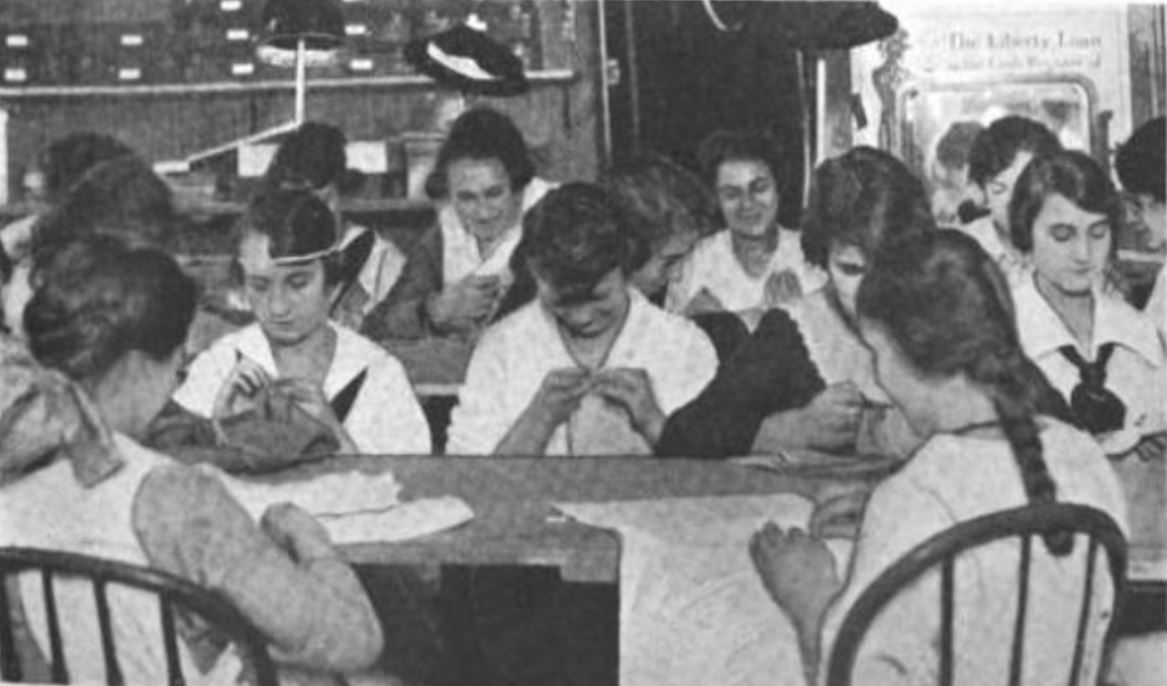
Courses included “custom dressmaking, children’s custom-made clothing, custom millinery, factory garment making-dresses and waists, muslin underwear, shirts and special machine work such as machine hemstitching, buttonholes, machine embroidery, two needle stitching, and bonnaz embroidery…” In a school week of 32 hours, more than half of the time was “devoted to trade work.” “The course of study” included “power-machine operating, dressmaking and millinery, with such related subjects as business methods and English.” Special attention was given “to civics and good citizenship.”
Millinery Apprentices at the Girls Trade School, Philadelphia,” in Cleo Murtland, “Pennsylvania’s First Trade School for Girls.” The Industrial-Arts Magazine, Vol. 7 – (Milwaukee: The Bruce Publishing Company , 1918)
In 1919, Murtland left her position at Pine and Quince for an associate professorship at the University of Michigan where she tackled similar challenges and opportunities in Detroit.
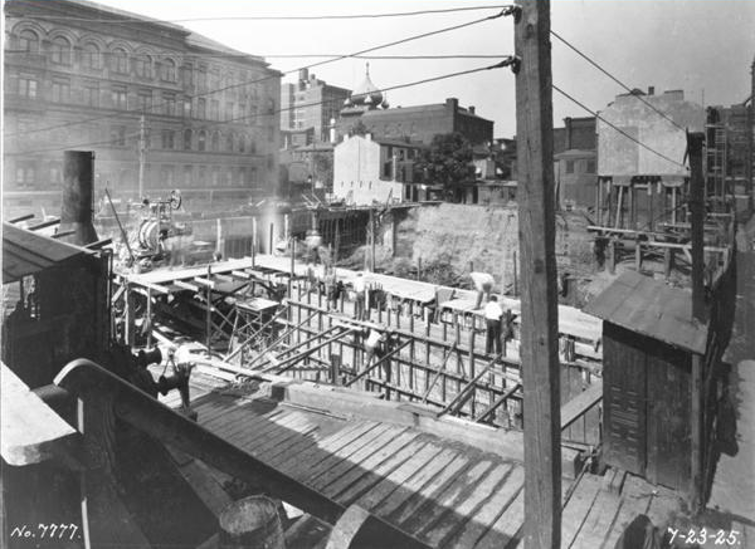
Back in Philadelphia, the case for vocational education for girls and young women had been made. And in December 1925, the Inquirer reported the laying of a cornerstone for a new, five-story trade school for girls and women. When operational, the Helen Fleisher Vocational School at 13th and Green Streets would accommodate 1,200 girls and women.
Helen Fleisher Vocational School under construction, 13th and Green Streets, July 23, 1925 (PhillyHistory.org)
In theory, vocational education would position young women to earn higher wages. In reality, according to the 1922 Report of the Survey of the Public Schools of Philadelphia, there was no minimum wage law in Pennsylvania. Girls and women comprised a fifth of the workforce but earned only a tenth of the total wages. In factories and mills that produced clothing, two thirds of the workers were female. They earned only a third of the total wage.
In industrial early 20th-century Philadelphia, the glass ceiling was fabric rather than glass. And it was stitched tightly, one might say irrevocably, in place.
[Sources: Franklin Davenport Edmunds, The Public School Buildings of the City of Philadelphia from 1845 to 1852. (1915); Cleo Murtland, “Pennsylvania’s First Trade School for Girls,” The Industrial Arts Magazine, Vol. 7 (Milwaukee: The Bruce Publishing Company, 1918); Report of the Survey of the Public Schools of Philadelphia, Volume 3 (Public Education and Child Labor Association of Pennsylvania, 1922). The Philadelphia Inquirer: “Consumer’s League Official Resigns – Philadelphia to Have Girls Trade School,” May 27, 1914; “To Aid Untrained Girls,” October 1, 1916; “Education Board Takes Trade School for Girls,” January 3, 1918; “A Trade School for Girls,” January 6, 1918; “To Teach Trades to Girls,” September 8, 1918; “School to Broaden Training for Girls in Philadelphia Industry,” November 21, 1920; “The Board of Education Programme,” January 15, 1925; “Cornerstone Laid For Trade School,” December 16, 1925.]
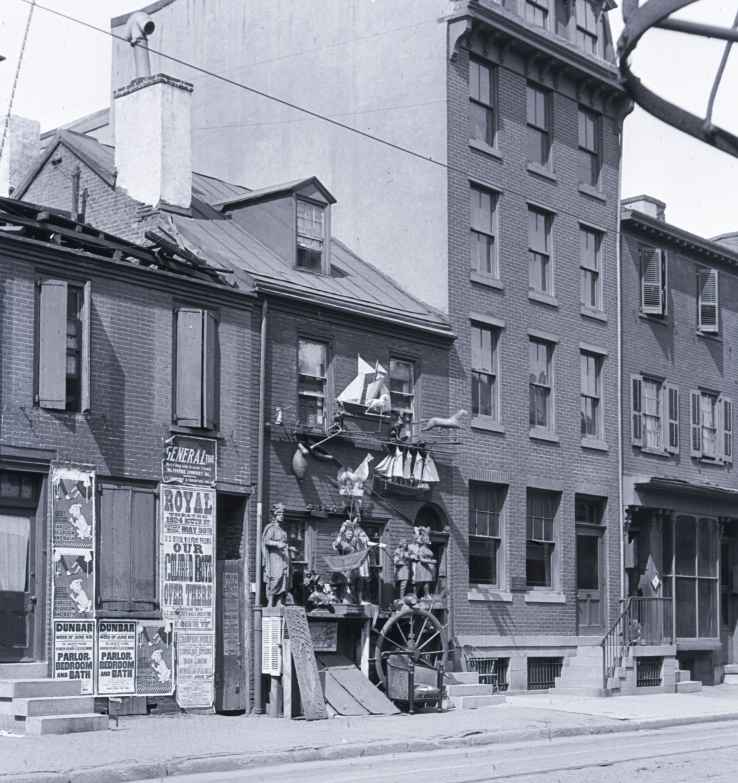
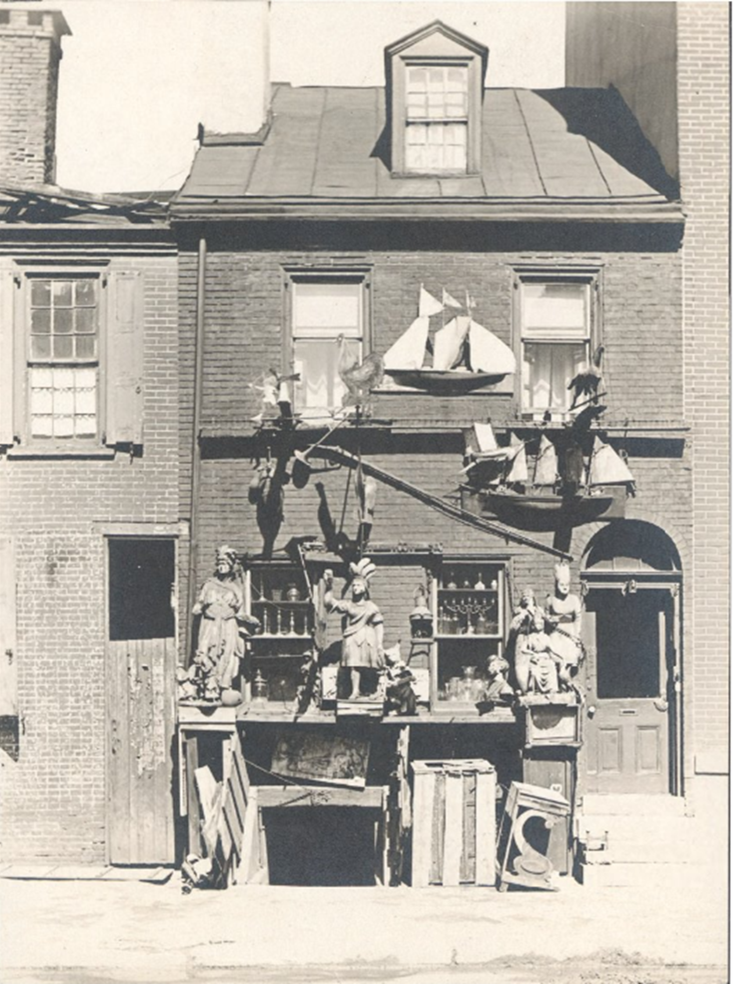
A century ago, 1237 Pine Street, also known as James Eham’s Antique Store, formed a distinctive western anchor on what would become known as Philadelphia’s Antique Row.
Eham’s eclectic tastes were on full display here. As the Library Company captioned one of its two photographs of the Eham’s façade, he “heavily adorned” his emporium “with antiques and curiosities, including cigar store Native Americans, ship models, a rooster weather vane, and a ship’s helm. Posters, including a playbill for a production of “Our Colored Boys Over There” at the African American playhouse, the Royal Theater (opened in 1920), cover an adjacent building.” Eham, we learn, was “born enslaved in Virginia, settled in Philadelphia in 1876 and soon after became an antiques dealer. By 1927, he owned two antique stores in Philadelphia and one in New York.”
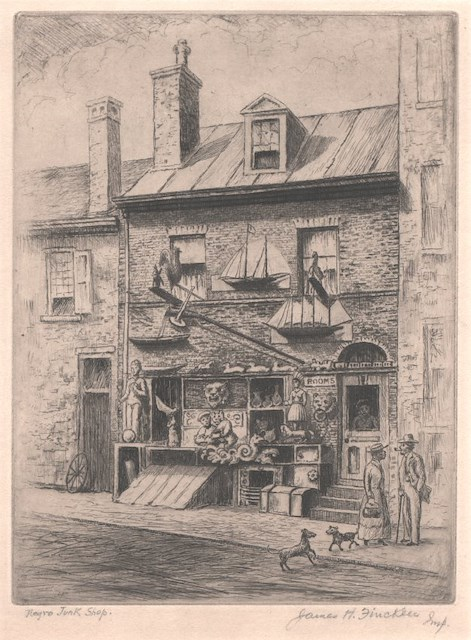
When artist James Horsey Fincken chose Eham’s shop as a subject for one of his etchings, he provided a title that can only be described as dismissive. Fincken’s “Negro Junk Shop” might have seemed a charming moniker to the artist and his following, but it denied the greater story of Eham’s role in Philadelphia’s antique trade. According to Eham’s obituary published in The Philadelphia Tribune on December 11, 1930 he “had been in the antique exchange and collection business since his arrival in Philadelphia in 1876.” The headline of that obituary labelled Eham as nothing less than a “Pioneer Antique Dealer.”
“Negro Junk Shop.” Etching by James Horsey Fincken, ca. 1930 (Gift of Josephine Wood Linn / Atwater Kent Collection at Drexel.)
Disclosure: The author’s family has been in the antiques trade on Pine Street since the late 1940s.
Everyone in the ceremonial photo-op at the gigantic “Reading Depression” featured in our previous post at PhillyHistory knew handshakes could only go so far. The December 17, 1898 celebration was tainted by the knowledge of a recent death of a laborer. And that was hardly the first causality.
Philadelphia & Reading Railroad Depression, 22nd and Pennsylvania Avenue, Looking West, Detail. 1896 (PhillyHistory.org)
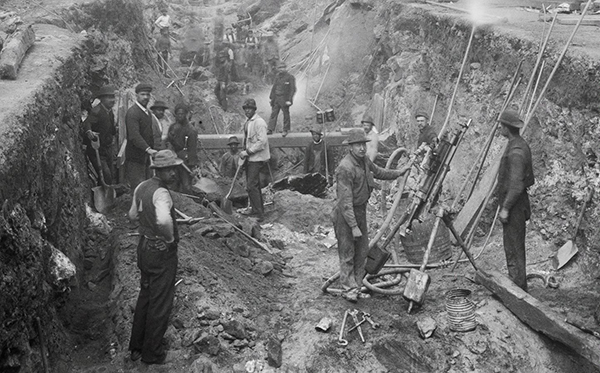
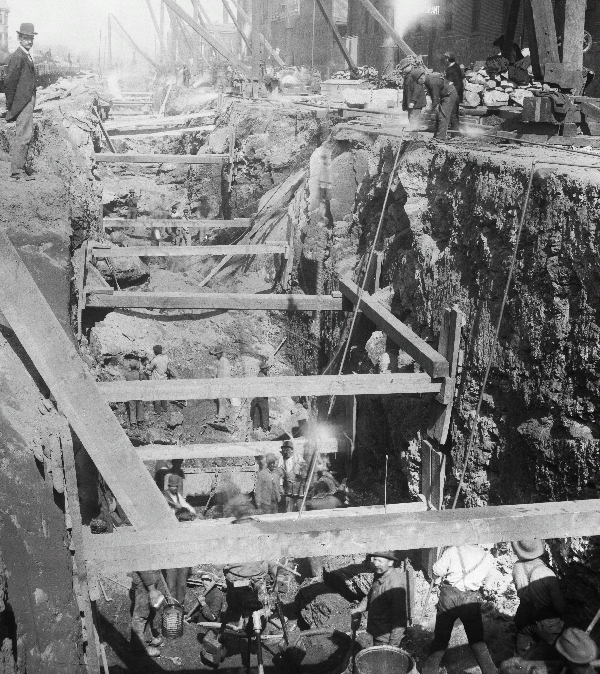
Michael O’Hearn, aged 38, and Benjamin F. Moore, 50, had been “working in a pit about 15 feet below the surface [at Pennsylvania Avenue, above 16th Street] when the supports which held the sides of the embankment gave away. The loose earth tumbled down on the men. All escaped, but O’Hearn and Moore, who were almost buried from view. The other workmen went to their aid at once, and succeeded in extricating them.” Both were taken to the Hahnemann Hospital. Moore would recover, but “O’Hearn became unconscious soon after his arrival at the hospital and died within an hour.”
We know of two other fatalities from a year earlier. And one, under the headline “Killed In The Subway” suggested even more, referring to an “already long list of fatalities in connection with the construction of the Reading subway.”
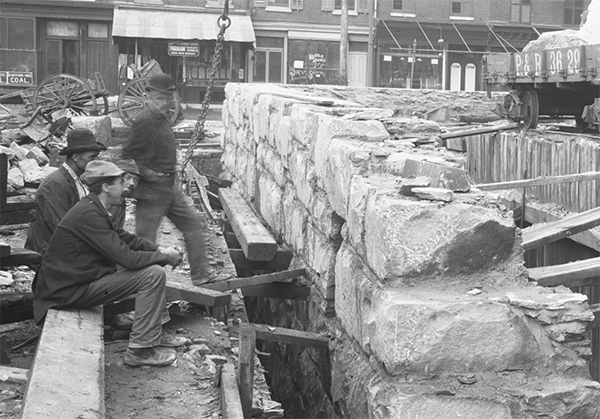
James Last died in a gruesome accident in July 1897. This father of several small children, “a laborer, in the employee of contractors E. D. Smith & Co., met a terrible death in falling headfirst into a trench . . . at Twenty-third and Pennsylvania Avenue.”
Attempting to avoid a collapse at the edge of a trench where he was working, “Last dropped his hoe. . . and ran rapidly along the side, picking his way as well as he could among the loose timbers.” His “foot must have tripped over one of those obstacles, for suddenly he literally dived over the side of the trench and went headlong down to the bottom. In an instant the cry: ‘Man hurt’ went up, and hundreds of people crowded to the edge of the trench. Lanterns were brought out, and covered with blood, the body of the unfortunate man was found. Last’s head was bent under his body and his arms hung limply by his side.” His skull was fractured in two places. Last’s arms were broken and, due to a too-hurried recovery in a construction bucket, his legs “were badly torn and mangled.”
Last never regained consciousness and died minutes after admission to a nearby hospital.
Five weeks later the Reading Depression claimed yet another life, that of Fortunato DiCola, 37, of 7th and Fitzwater Streets. DiCola met his fate at 21st and Hamilton Streets.
Di Cola and Sabidino Felli were using a derrick and a boom to remove large rocks. One “had just been loosened in the pit thirty feet below” when “the men were raising the boom slightly, in order that a chain might be passed beneath it. Suddenly the large hook which help up the end of the boom broke, and the heavy timber fell over on the bank, where the men were standing. It struck Di Cola on the head, crushing his skull,” and also injuring Felli,” who survived.
Philadelphia & Reading Railroad Depression, 22nd and Pennsylvania Avenue, Looking West, Detail. April 3, 1897 (PhillyHistory.org)
How many other laborers were killed and injured over the course of three years at this gigantic infrastructure project? Only research will enable us to build a comprehensive, accurate list of casualties. And how would we like to memorialize these victims on the streets of Fairmount? Or would we prefer to chalk up these fatal incidents as unavoidable, inevitable costs of urban development in Philadelphia’s Gilded Age?
Philadelphia & Reading Railroad – Depression Excavation and retaining wall – looking south to Callowhill Street – West of 16th Street, 1897 detail (PhillyHistory.org)
Sources: From the The Philadelphia Inquirer: “Killed in the Subway, James Last, a Workman, Meets a Terrible Death, July 8, 1897; “Death on Subway, Another Workman Meets with Fatal Accident,” August 13, 1897; “Another Subway Fatality, Michael O’Hearn, Injured by a Cave-in, Dies in the Hospital” December 11, 1898.]
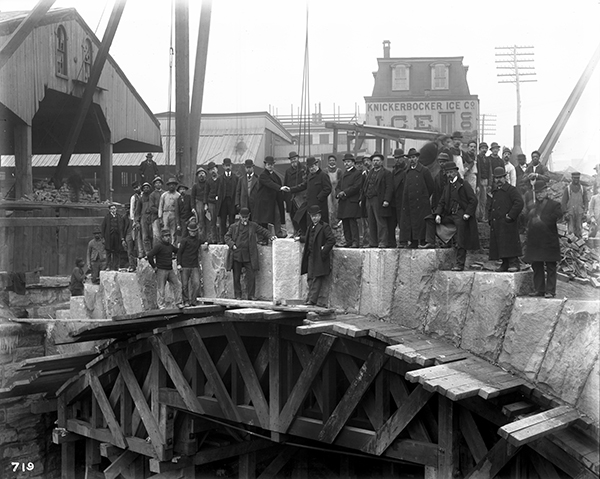
Keystone Setting, East Portal of the Tunnel near 21st and Hamilton Streets, December 17, 1898 (PhillyHistory.org)
One September afternoon in 1898 an Inquirer reporter, accompanied by an artist, “walked over the entire route” of the Reading subway, a massive project stretching from 12th Street to 30th Street.
When completed, this now-defunct subway would accommodate locomotives hauling raw materials and freight through one of the city’s most industrialized neighborhoods. Yet one wouldn’t know it – or even see it – at street level. The entire project would be topped by a landscaped boulevard leading from Hamilton Street and 22nd to the entrances to Fairmount Park at Spring Garden and Green Streets. One might say this project foreshadowed the much more famous Parkway, which was also originally slated to have its own subway.
Beneath the diagonal of Pennsylvania Avenue, this Reading subway would have “a series of thirteen air shafts in the roof of the tunnel” distributed over its entire length at an average distance apart of 75 feet. Each one would be “beautified” with “plots of grass and shrubbery…enclosed by an ornamental iron railing and a granite curb.”
Beneath were massive arches, many of which appeared to the reporter to be “capable of sustaining hundreds of tons more weight than they will ever be called on to sustain.”
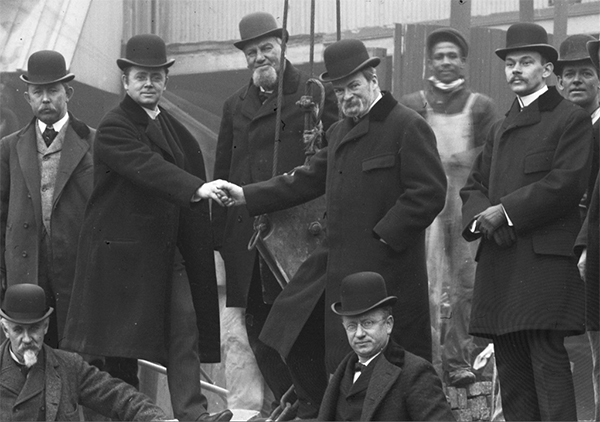
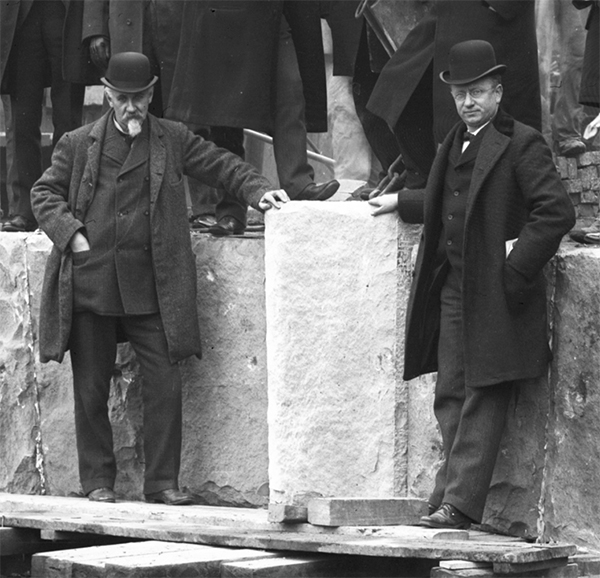
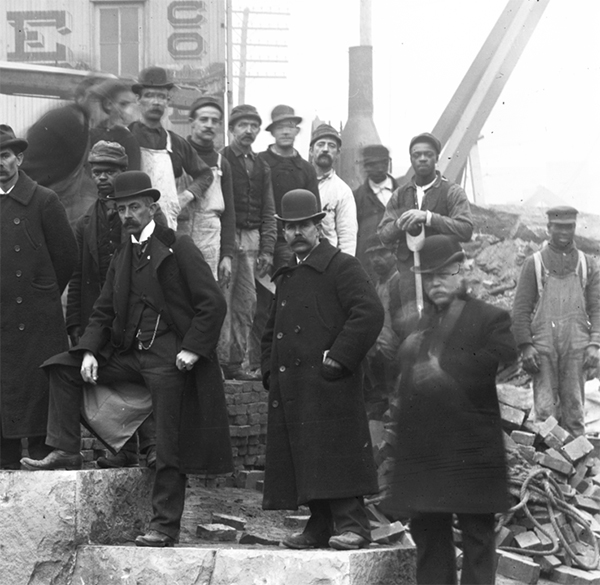
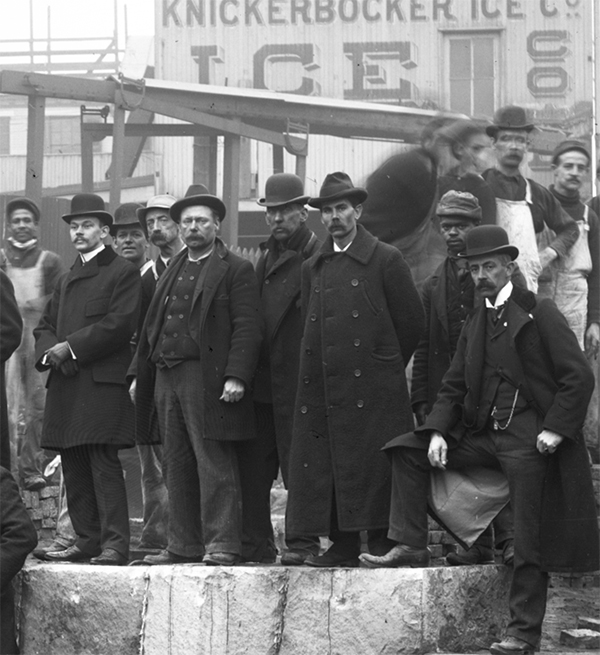
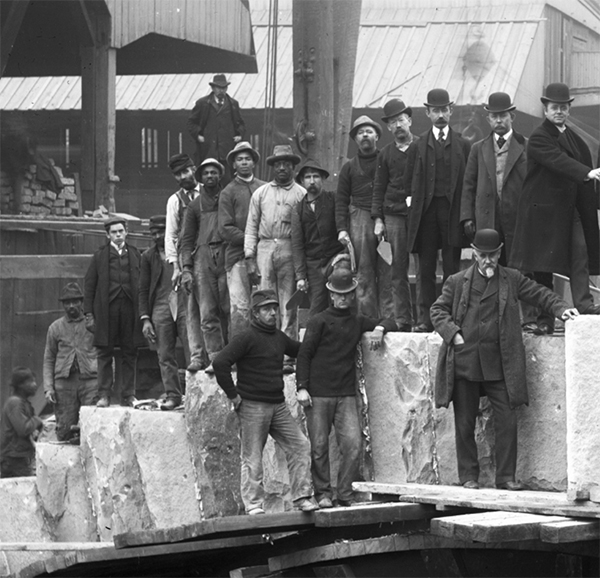
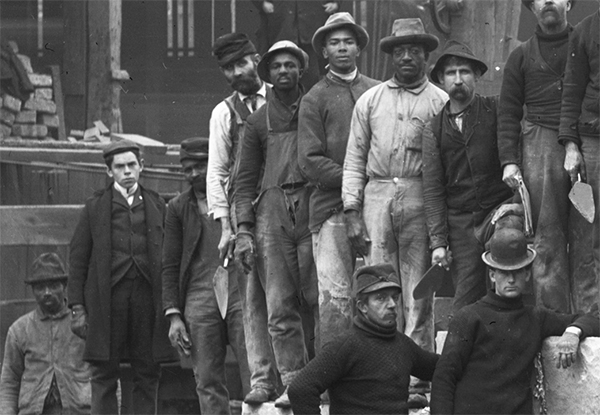
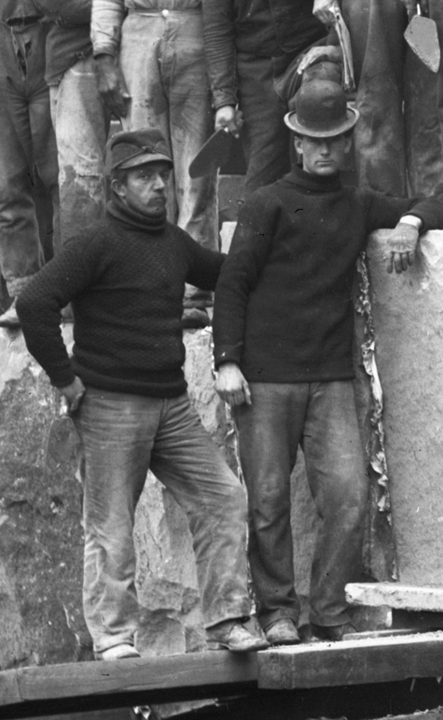
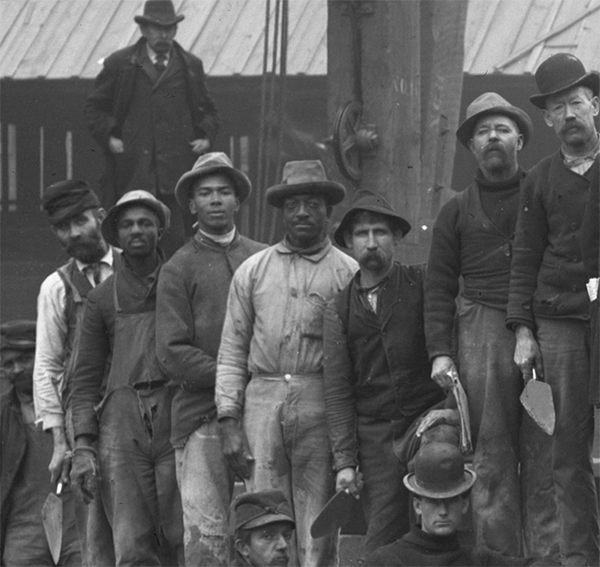
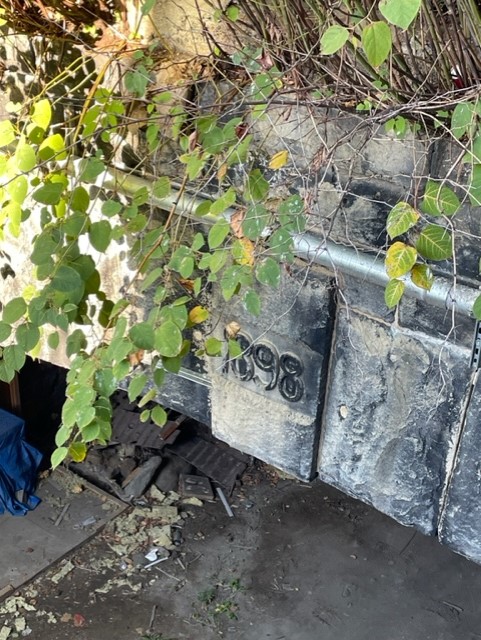
A few months later, the Inquirer reporter witnessed the completion of one of the 2,710-foot tunnel’s 52-foot arches. “A five-ton keystone was placed in position yesterday by chief (George S.) Webster, of the bureau of surveys, in the arch of the subway tunnel, at 22nd and Hamilton Streets.” A city photographer was there to document the dedication ceremony, which included the entire project team: politicians, contractors, stone masons and laborers, tools in hand.
Sources: “Hard at Work on the Subway,” The Philadelphia Inquirer, September 19, 1898; “The Subway Keystone,” The Philadelphia Inquirer, December 18, 1898.
George S. Webster, Chief Engineer, Bureau of Surveys (left) shaking hands with an unidentified man. Other unidentified participants on the project team follow.
The Keystone in 2023. South side of 2100 block of Hamilton Street.
It was 1952 and Philadelphians were searching for a new identity. Democrats had taken City Hall and urban renewal dollars were poised to pour in from Washington. Gimbel Brothers Department Store at 10th and Market Streets had sponsored a “Better Philadelphia Exhibition“ and now, with the betterment begun, executives wanted to celebrate the new and improved city in a triptych of murals over a bank of store elevators. They invited a stable of artists to propose paintings of lasting civic and cultural value.
Morris Berd’s Industrial Philadelphia – the Workshop of the World and Harry Gricevics’ visionary Philadelphia of Tomorrow breezed through the review process. But when the committee saw Alfred Bendiner’s study of exuberant, twirling and colorful strutting on a Broad Street, they grew uncomfortable. Although the committee liked Bendiner’s style, the mummers weren’t dignified enough, or so they told the artist. If you want the commission, find a more appropriate subject, they told him.
Bendiner hadn’t anticipated that his confident, circuslike renderings of average Philadelphians, mocking and mimicking on New Year’s Day might fail to fit some unspoken agenda. But the committee’s inclination toward white-collar Philadelphia – the starchier the better – was now obvious. They didn’t want sequins and feathers. Perhaps top hat and tails would do?
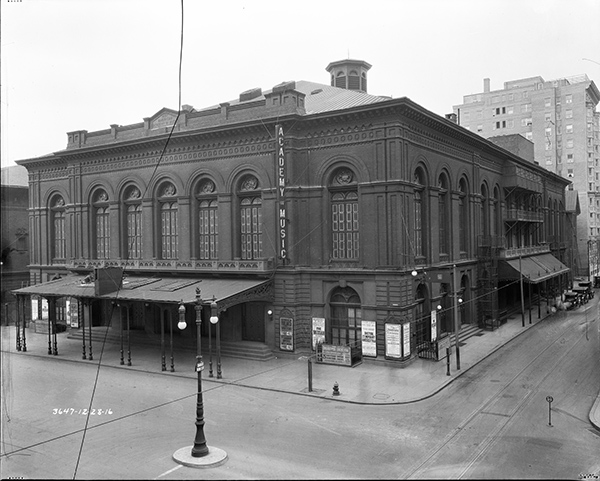
Academy of Music. Southwest corner of Broad and Locust Streets, December 28, 1916. Charles P. Mills, Photographer. (PhillyHistory.org)
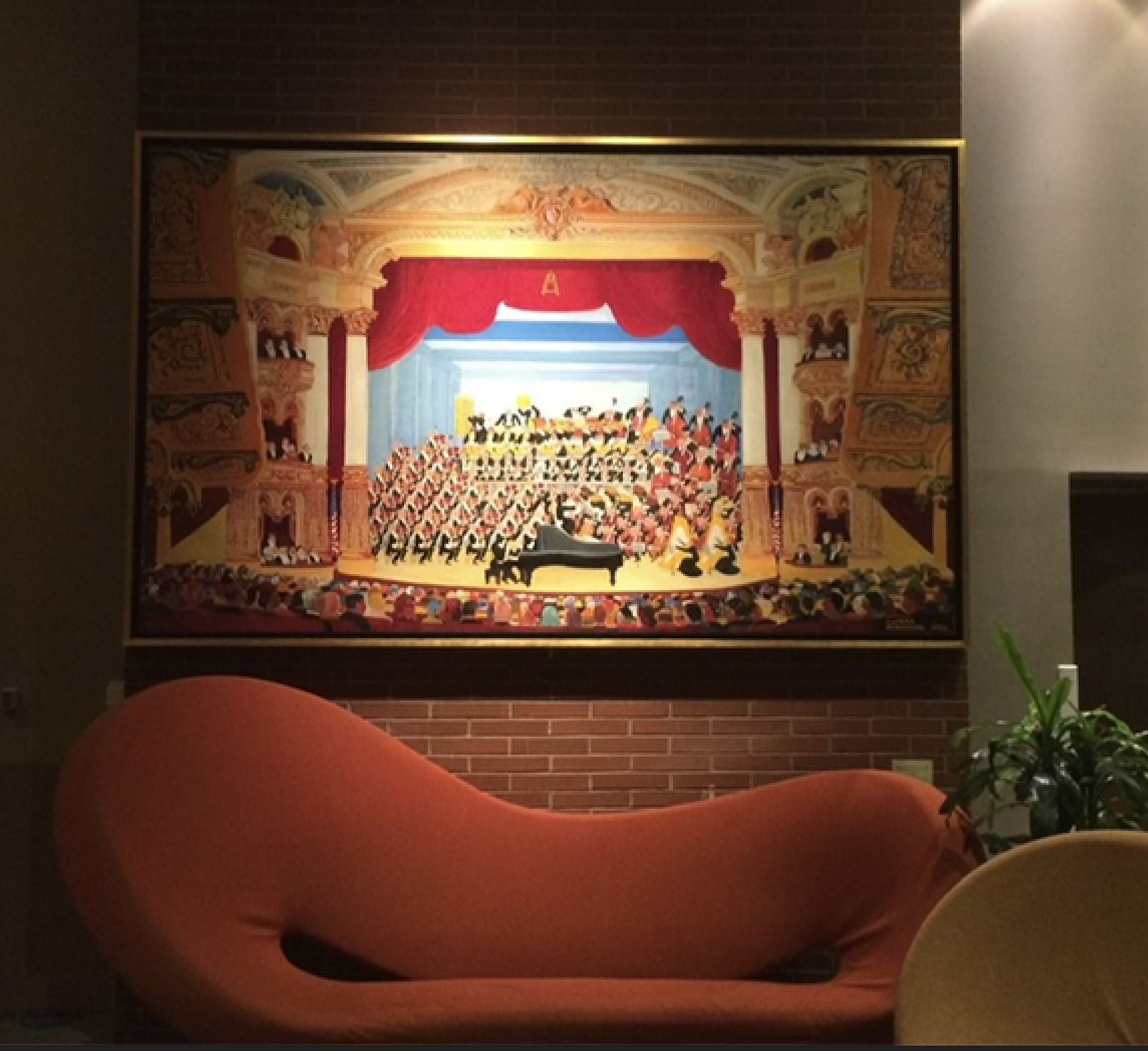
This shift pose no real problem for Bendiner. For years, his sketches of Igor Stravinsky, Jascha Heifetz, Marian Anderson, Sergei Rachmaninoff, and others had accompanied reviews of performances in TheEvening Bulletin, and he had just come out with his first book, Music to My Eyes, a collection of 51 caricatures of performers on stage at the Academy of Music. Bendiner had dedicated the book to Rachmaninoff, whose memorable Philadelphia premiere of his Piano Concerto No. 3 Bendiner sketched in December 1939. “Rachmaninoff rode his own meddlesome musical steed in a fashion that held his audience spellbound,“ wrote one reviewer.
But in his revision for the Gimbel’s commission, Bendiner threw a subtle, silent curve. He replaced the profile of Wolfgang Amadeus Mozart in the medallion over the Academy’s proscenium arch with that of his wife, Betty. Call it artistic license. Call it sleight-of-hand. Bendiner introduced onto the the staid Academy and the walls of Gimbel’s Department Store, a little Mummeresque mockery.
Philadelphia Orchestra, Academy of Music, oil painting by Alfred Bendiner, 1952. At the Kimmel Center for the Performing Arts.
All three paintings were removed before the Gimbels flagship store at 9th and Market Streets was demolished as part of the city’s continued renewal. (Decades later, its site remains undeveloped.) The Bendiner eventually followed the Orchestra to the Kimmel Center for the Performing Arts at Broad and Spruce Streets – again at home by an elevator.
+ + +
Adapted from “How the Orchestra Beat the Mummers” published in The Philadelphia Almanac and Citizens’ Manual for 1994 (The Library Company of Philadelphia, 1993), page 127.
Philadelphia’s outbursts of street violence in the 1830s grew even more familiar in the following decades. “By any measure,” writes historian Michael Feldberg, “the period from 1835 to 1850s was the most violent in Philadelphia history.”
And then something gave.
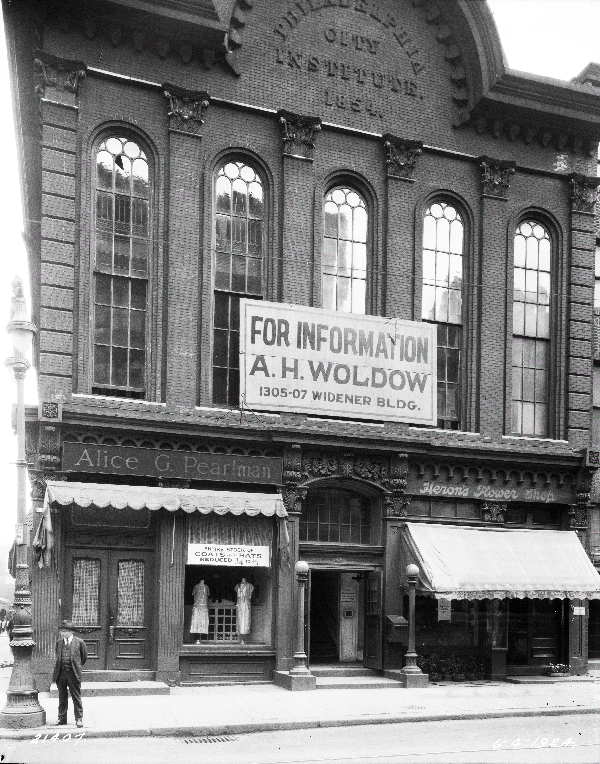
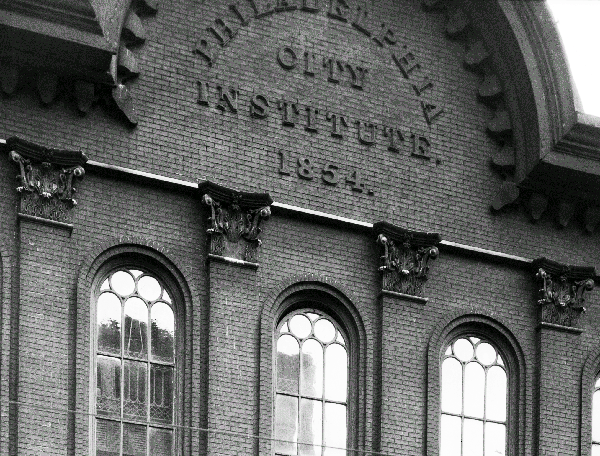
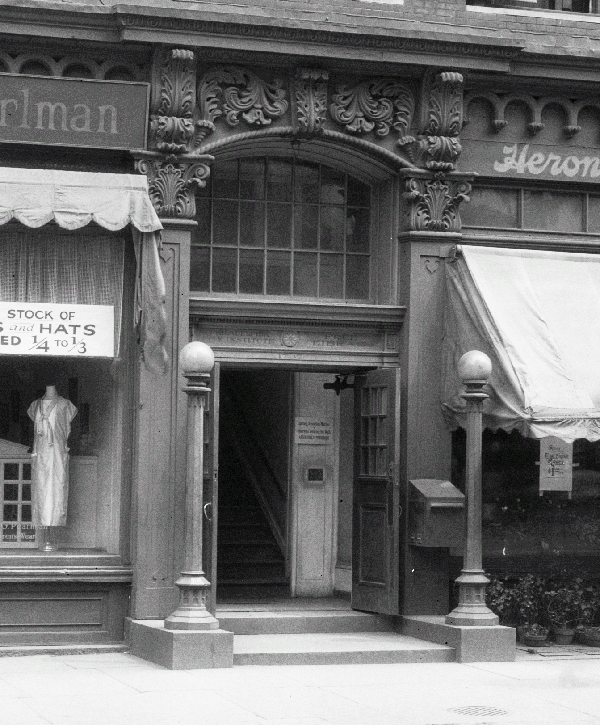
[Philadelphia City Institute] View of Northeast Corner – 18th and Chestnut Streets. June 4, 1924 (PhillyHistory.org)
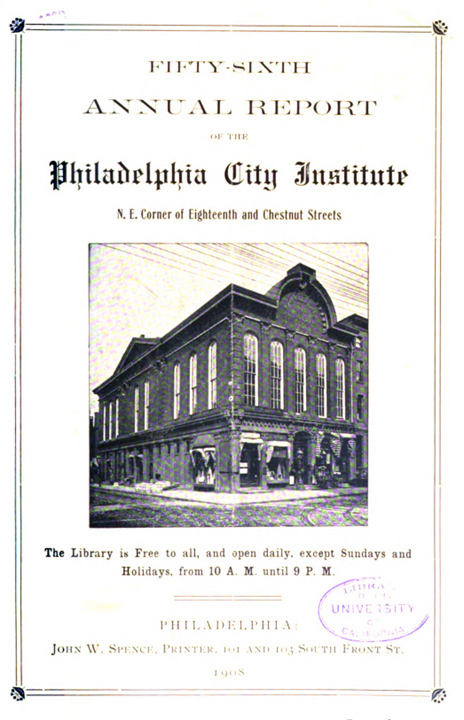
Forty-Fourth Annual Report of the Philadelphia City Institute (Philadelphia, 1896 (Google Books)
A group of well-intentioned, philanthropic citizens donated $34,000 for what they called the Young Man’s Institute. The idea was to stem the tide of violence by providing appealing, accessible and constructive alternatives.
The thinking, according to contemporary reports: Philadelphia was home to “a large class of young persons, who, from the poverty or neglect of parents, or having none to care for them, have very little opportunity” for formal education. “Common labor or the workshop claims all their time. They grow up in the vigor of youth and manhood with little moral or social restraint.”
And so, “their evenings are given to the streets.” They “frequent the ever open groggeries, drinking saloons, beer shops and other places” and are “tempted to occupy their leisure moments in worse than idleness…” They “descend step by step until they are irretrievably ruined.” What might be done “to rescue from the streets and from the downward career of vice, profanity, and ruin, many of these idle and vagrant boys?” Leaders of the Young Man’s Institute considered the Apprentices Library as a potential model. Since 1820, this institution promoted “orderly and virtuous habits” as well as “the desire for knowledge” to “advance the prosperity and happiness of the community.” But with only one location at 5th and Arch Streets, the Apprentices Library had limited impact. The Young Man’s Institute would build branches where needed, in several of the city’s most vulnerable and volatile sections. Collectively, they would strive to transform the city’s youth and improve “public peace and the safety of the community.”
[Philadelphia City Institute] View of Northeast Corner – 18th and Chestnut Streets. Detail. June 4, 1924 (PhillyHistory.org)
In time, branch locations would include the Moyamensing Literary Institute at 11th and Catherine, the Mechanics’ Institute of Southwark at Fifth street below Washington Avenue, the West Philadelphia Institute at 39th Street above Market Street, the Kensington Literary Institute at Front Street and Girard Avenue and the Spring Garden Institute at Broad and Spring Garden Streets. Branch locations also included the Philadelphia City Institute at 18th and Chestnut Streets, which served the western side of Center City. Together, these facilities would “provide an opportunity of developing the crushed genius and honorable ambition of the young men of poverty and toil.”
At 18th and Chestnut, the Philadelphia City Institute’s corner-stone was set in place on May 22, 1854 and the building opened the following March. On the second story was a “splendid Lecture Room, 75 by 44 feet, and a Reading Room, 40 by 38 feet.” The Board of Managers had the highest of hopes imagining that “future Franklins, Rittenhouses, Fultons, and Awkrights [sic] may date their fortunes and their fame on the day they first entered our library.”
From the start, free access was universal. “Every man over 14 years of age is admitted. . . without charge, on a certificate of good character and inability to pay.” The reading room opened every evening at 6pm, and remained open until 10pm, every day except Sunday, all year round.
Books were arranged in categories: history, biography, arts, mechanics, voyages and travels, and literature, augmented by “a well-selected Library for reference and circulation.” Books were “in open cases unobstructed by wire netting or wooden fences” as in other libraries. Readers had “free access to the books and the valuable privilege of selecting books which they desire to examine.”
At first, the Philadelphia City Institute offered 832 books and attracted an average of twelve readers per day. Rapid growth ensued and in the final years of the 19th century, the library had more than 15,000 books and accommodated an average of more than 360 readers per day.
[Philadelphia City Institute] View of Northeast Corner – 18th and Chestnut Streets. Detail. June 4, 1924 (PhillyHistory.org)
In addition to the library and from the start, the Philadelphia City Institute offered “a course of Lectures on useful knowledge and general literature” as well as classes in other categories. Weekly lectures and a free night school launched the first year with popular topics featuring “Evils of Our Times” presented by Philadelphia’s Mayor, Richard Vaux. Other lectures included “Young America,” “Tendencies of Modern Science,” “Culture of the Beautiful,” “William Penn and the Holy Experiment,” and “Education, Intelligence, and Morality, the Pillars of Freedom.” To take stock of the entire project, lectures included “the City Institute and Its Results.”
But, according to the annual reports, lectures “failed to draw audiences of the class of persons intended to be reached—young workingmen.” For a time, music was added on Saturday evenings. and while these concerts attracted “immense crowds of boys of all ages” many were “roughs’ of the streets” and “became troublesome” to both the Institute and its neighborhood.
About the same time, the Managers considered the possibility of adding a “Smoking Room” with games as a possible popular attraction. But upon further consideration they concluded the “excessive abuse of tobacco already prevalent with the young” and concluded it was neither “expedient or proper to add any inducement of that kind in the Institute.”
What did work, starting in the early 1870s, was a “night school for females whose education had been neglected.” This 17-week curriculum “opened … with marked success.” More than 100 attended.
The Institute continued at 18th and Chestnut until 1923, at which point the building was sold and the collection moved to West Rittenhouse Square. In the mid-1940s it joined with the Free Library of Philadelphia. And in 1956, the Philadelphia City Institute moved again, this time to 1905 Locust Street, where remains to this day.
“We claim to be the freest library in the world,” rightly bragged the Philadelphia City Institute in its vintage annual reports, “a fountain of intellectual refreshment, never stagnant, never stinted.”
[Sources: Michael Feldberg, “Urbanization as a Cause of Violence: Philadelphia as a Test Case,” in The Peoples of Philadelphia, (Temple University Press, 1973); John Richard Uberti. Men, Manners and Machines: The Young Man’s Institute in Antebellum Philadelphia, (University of Pennsylvania dissertation, 1977); Philadelphia City Institute Records 1852-1999. The Historical Society of Pennsylvania Collection #3023 PDF.
An Appeal in Behalf of the Philadelphia City Institute, For Improvement of Young Men. (Philadelphia: inquirer Book Press), 1855; First Annual Report of the Managers of the Philadelphia City Institute. (Philadelphia: Printed by G.T. Stockdale, 1856); Nineteenth Annual Report of the Managers of the Philadelphia City Institute (Philadelphia: G.T. Stockdale, printer, 1871); Twenty-second Annual Report of the Managers of the Philadelphia City Institute (Philadelphia: Mack & Braden, Book and Job Printers, 1874); Forty- First Annual Report of the Managers of the Philadelphia City Institute, (Philadelphia: John Spence, Printer, 1893);
“Philadelphia City Institute-To the Public,” The Philadelphia Inquirer, June 20, 1853; “Girls’ Night School,” The Public Ledger, October 30 1872; “Origin of Some Local Libraries.” The Philadelphia Inquirer, April 23, 1893; “The Philadelphia City Institute,” The Philadelphia Inquirer, April 16, 1894.
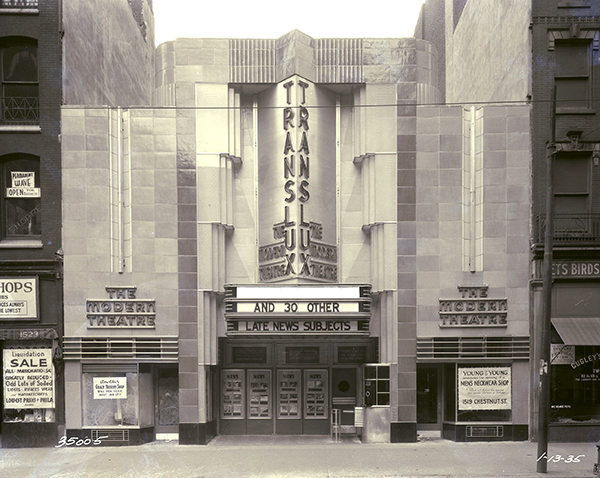
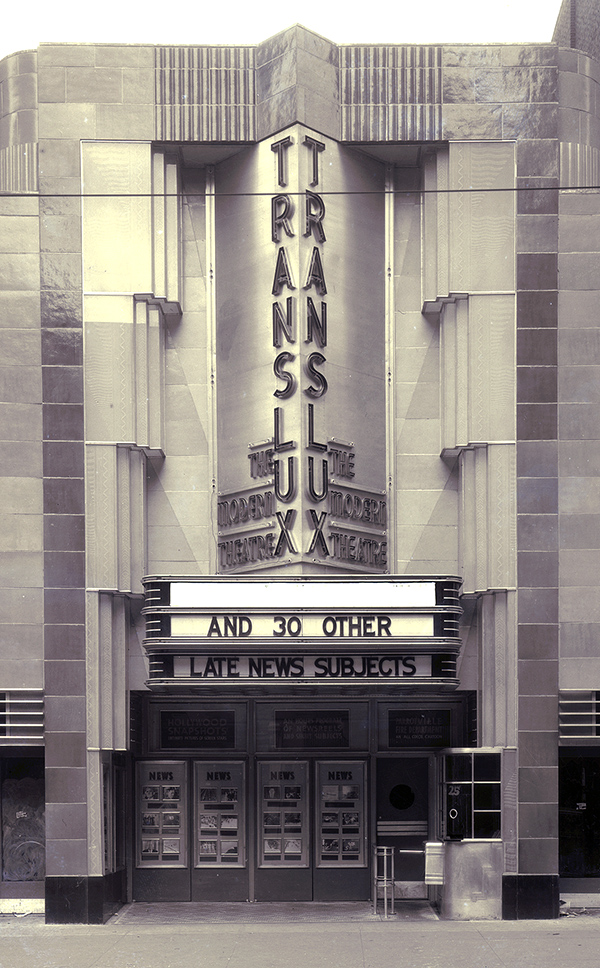
”A brand new idea in motion picture theaters here was launched last night,” boasted Inquirer film critic Mildred Martin. In the depths of the Great Depression, this brand new “intimate auditorium,” an Art Deco confection called the Trans-Lux, promised to transform traditional movie goers into 20th-century citizen-spectators.
Instead of screening Hollywood’s latest feature films, the Trans-Lux offered newsreels and other short films in a “small but charming and modernistic house seating only 493.” Relying on a counter-intuitive business plan that had recently proven itself in Manhattan, here was a distinct departure from gigantic, lavish movie palaces like the Boyd, the Stanley and the Mastbaum, with 2,500 seats, 2,916 seats and 4,700 seats, respectively.
Trans-Lux Theatre, 1519 Chestnut Street, January 13, 1935. (PhillyHistory.org )
Entering architect Thomas W. Lamb’s gleaming, streamlined design, patrons literally crossed the threshold of the latest media culture, participating in cutting-edge design, bleeding-edge technology, and up-to-the moment news.
“The new theater’s architecture, decoration and mechanics are all entirely modern,” wrote Martin. “There is no projection booth in the balcony. Everything – projectors, films, electric wiring, operator – is behind the screen. Special lighting effects flood the Trans-Lux Theatre with a soft glow which makes empty seats clearly visible. No tripping over legs in the gloom, no waiting for ushers, no hunting for lost hats, no worry about the safety of children because the theater is so well lighted.” Amenities included “attractive mezzanine lounge[s] with modernistic effects… telephone booths and other conveniences.”
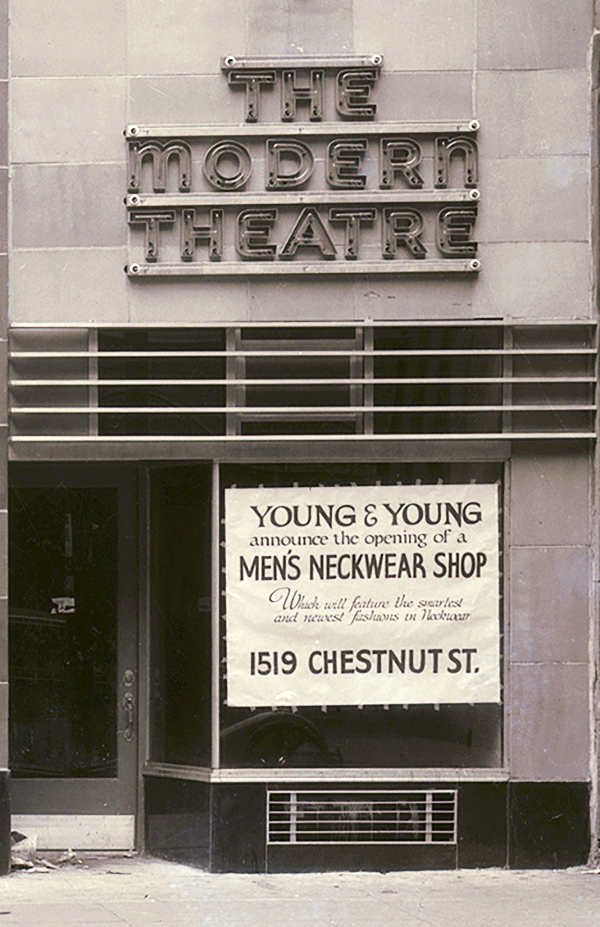
Detail. Trans-Lux Theatre, 1519 Chestnut Street, January 13, 1935. (PhillyHistory.org)
“Selected from the entire short subject output of all motion picture producers in America and foreign markets” newsreels at the Trans-Lux quadrupled what was available at “the average feature picture house.” Patrons viewed “a wide variety of topics” including “comedy, animal life, sports, cartoons, travelogues and novelty material of entertainment and educational value.” And they were offered hard news.
Beginning in 1935, this included newsreels under The March of Time brand, stories like the Dionne quintuplets, hobbies of Hollywood stars, and animated cartoons featuring Jack Frost and Popeye the Sailor. Regulars returned weekly for the latest adventure of Amelia Earhart, automobile racing accidents, and highlights bound for sporting history. And at the heart of every sixty-to-ninety-minute presentation was at least one newsreel of note.
Detail. Trans-Lux Theatre, 1519 Chestnut Street, January 13, 1935. (PhillyHistory.org)
In November 1935, this would be a 7-minute, 50-second March of Time production entitled Palestine (East of the Suez) that credited Adolph Hitler, “who has wrought upon Jews more evil than any man of his generation” with a wave of immigration from Germany to the Middle East.
“Fanned by the oratory of Hitler’s minister of propaganda, [Joseph] Goebbels, anti-semitism has swept Germany,” the narrator continued. “All books of Jewish authors are ordered burned in public squares. Authors, scientists, artists are driven from Germany. Bands of loud Nazi youth in storm trooper uniforms conduct terrorizing raids on Jewish citizens throughout the land, to the rest of the world’s shocked amazement.” Authentic film clips illustrated every line.
“These are the final blows of a long persecution which has been forcing Jews out of Germany by tens of thousands,” read the announcer. “World attention and sympathy for such refugees as Dr. Albert Einstein welcomed in America, has obscured the plight from Germany of some 80,000 German Jews to all parts of the world … 6000 to America, 23,000 to Palestine. . . . a new Palestine and the land of promise.”
In Ohio, a board of motion picture censors deemed some segments “irrelevant” and “anti-Nazi.” E. L. Bowsher, the state’s chief censor, forced theaters “to cut 150 feet of film” from each copy of the newsreel.
No censorship was reported at Philadelphia’s Trans-Lux, which was about to complete its first year. At that anniversary, Trans-Lux manager William Matteson praised “Philadelphia’s interest in a theatre devoted exclusively to newsreels and short subjects” adding “we are happy to state that our experiment has proved entirely successful.”
Before long, Trans-Lux chain was operating in a dozen cities.
In 1938, when The March of Time produced a16-minute news feature entitled Inside Nazi Germany, criticism came from all sides. According to film studies historian Joseph Clark, Inside Nazi Germany “was denounced as both pro-Nazi and anti-German propaganda.” The Warner Brothers chain of theatres refused to screen it. At the Trans-Lux Theatre in New York’s Time Square, according to Clark, “there were a few ‘Heils’ for Hitler and an opposing and equivalent number of ‘Pfui,’” and some fist-waving audience members had to be separated.” But Inside Nazi Germany was not censored there Quite the opposite. Trans-Lux executives introduced the newsreel on the night of January 20, 1938 with the following projected on the screen:
“NOTICE. The issue of March of Time you are about to see has caused much controversy. Our policy is to fearlessly present any worthy film released by a recognized American producer. We therefore present uncensored and impartially the following subject.”
Fifty-five years later, The Library of Congress designated Inside Nazi Germany as “culturally significant” and added it to the United States National Film Registry for preservation in perpetuity. The newsreel also survives online. But Philadelphia’s Trans-Lux theatre does not. In the 1950s it became a first run theater. In the 1970s its distinctive vintage façade was replaced.
Today, the building is a sneaker emporium.
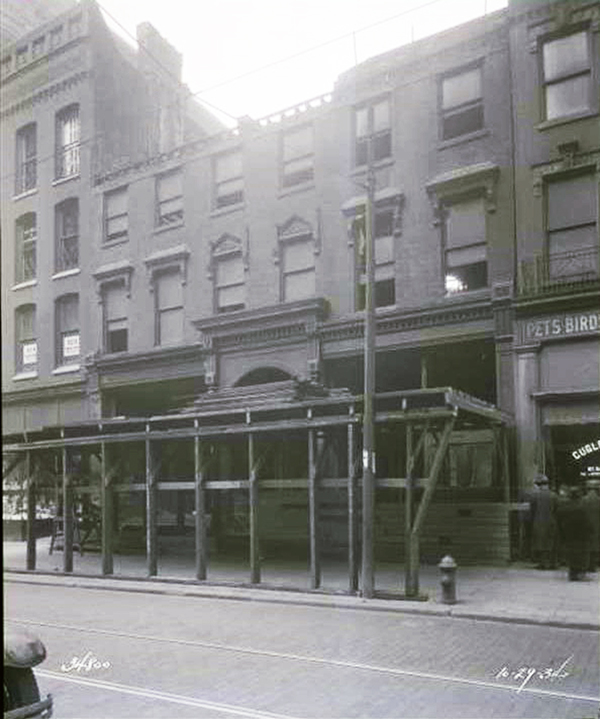
1519-1521 Chestnut Street, October 29, 1934. (PhillyHistory.org) Demolition of the Samuel T., Freeman & Co. auction rooms to make way for the Trans-Lux Theatre.
[Sources: In ThePhiladelphia Inquirer: “Chestnut St. Site Leased at $500,000 for New Movie.” Aug 31, 1934; “Trans-Lux Theatre Opens Tomorrow,” December 30, 1934; Mildred Martin, Trans-Lux theater has its inaugural, December 31, 1934; “Film Censors Ban Anti-Nazi Scenes,” October 27, 1935; Trans-Lux, “March of Time” [advertisement], November 3 1935; “Trans-Lux Year Old,” December 31, 1935.
The March of Time Newsreels [Synopses]. February 1935 – August 1951. PDF; “Deletion of film brings protest,” Evening Star, Washington D.C. October 27, 1935; March of Time, Volume 1, Episode 7, “Palestine (East of the Suez)” [1935]. Transcript.
Joseph Clark, News Parade: The American Newsreel and the World As Spectacle (University of Minnesota Press, 2020); Raymond Fielding, “Mirror of Discontent: The March of Time and Its Politically Controversial Film Issues,” The Western Political Quarterly , March., 1959, Vol. 12, No. 1, Part 1; URL; Irvin R. Glazer, Philadelphia Theatres, A‑Z: A Comprehensive, Descriptive Record of 813 Theatres Constructed Since 1724 (New York: Greenwood Press, 1986)].
Morton Livingston Schamberg believed in the power of art, specifically modern art. As a Philadelphia-born and trained artist who studied at the Pennsylvania Academy of the Fine Arts then Paris, Schamberg put his work, and his faith, in New York’s Armory Show in 1913. He also stepped up as both practitioner and advocate for all things modern in his hometown, where Schamberg was way ahead of his time.
In a pre-Armory Show essay published in the Philadelphia Inquirer, Schamberg provided what art historian Wilford Scott called an “eloquent defense of modern art.” Joseph Rishel, of the Philadelphia Museum of Art, much later praised the essay as “lucid” but also “prudent, given the anticipation of hostility from his audience.”
Schamberg attempted “to place modern painting in some historical perspective,” stating that “the art of Cezanne, Matisse, of Picasso, etc. is based upon the same ideas as that of Italy, Greece, Egypt, India, China, Africa or Mexico, in fact, of the art of all the centuries since its first manifestations.”
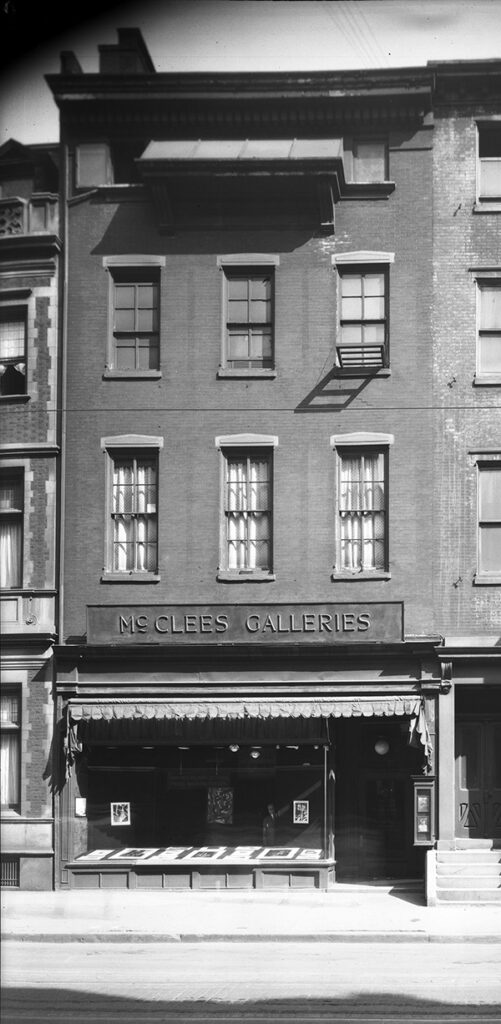
McClees Gallery, 1507 Walnut Street. March 25, 1927. (PhillyHistory.org)
But much of the Philadelphia art establishment didn’t buy Schamberg’s argument. Helen Henderson, the Inquirer’s art critic, admitted that modern works seemed “replete with a thousand intoxicating possibilities” and might ultimately “rouse us from indifference.” But not quite yet. Most still considered work of the Post Impressionists as “weird shrieks” leaving art lovers with “nothing…of what they knew and loved but the frames.”
Schamberg had his work cut out for him.
Three years later, with fellow artist Lyman Saÿen, Schamberg seized the opportunity to assemble and present “a small but brilliantly chosen” and, according to Rishel, “boldly” titled “miniature version of the Armory Show.”
Finally Philadelphians might just be willing to dip their collective toe in the new and exciting.
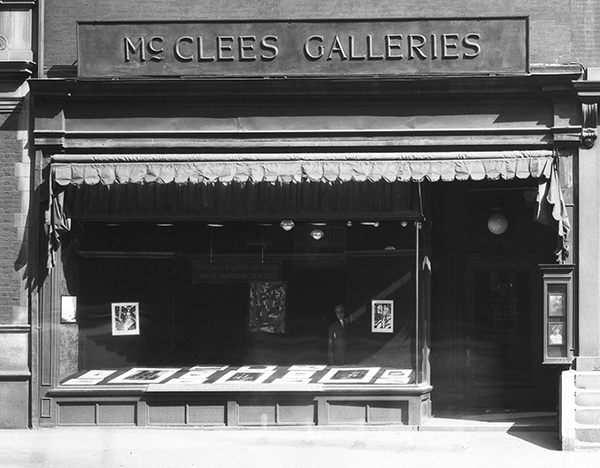
McClees Gallery, 1507 Walnut Street. March 25, 1927 (PhillyHistory.org)
“Philadelphia’s First Exhibition of Advanced Modern Art” opened at the McClees Gallery, 1507 Walnut Street on May 17th, 1916. According to Sylvia Yount, formerly of the Pennsylvania Academy of the Fine Arts and more recently the Metropolitan Museum of Art, this was “the first major presentation of avant-garde art in Philadelphia.”
Henderson noted the success of Schamberg’s “little exhibition of modern art.” It “created no little interest in the city, proving how ready is the public to visit art exhibitions of a live and interesting character. The exhibition proved the most popular one ever held in this gallery, and attracted an unprecedented number of visitors.”
In addition to selecting, arranging and hanging the show, Schamberg embedded himself in the gallery as an on-site interpreter, engaging visitors interested in understanding modern art, much as Alfred Stieglitz did at 291, his gallery in New York. And more: Schamberg wrote a preface to the show praised by Henderson as “excellent and illuminating.” This would “very much assist the spectator to whom the pictures appear enigmatic.”
According to Scott, the selection was “intended to reveal how the modern artist had discarded the mere ‘story-telling’ elements of traditional art, in order to concentrate on the embodiment of ‘pure esthetic emotion’ of abstract compositions.” But words could only do so much. To achieve a complete understanding of this new “psychology of aesthetics” and to thoroughly grasp how non-representational art could lead to “purely visual pleasure,” that would require both “time and familiarity.” Schamberg concluded his preface with this advice: “The best answer could be found in the pictures themselves.”
And what, exactly, was hung in this watershed exhibition? Works by artists both foreign and American, including several on the threshold of iconic fame: Constantin Brâncuși, Georges Braque, Jean Crotti, Andre Derain, Raoul Dufy, Marcel Duchamp, Raymond Duchamp-Villon, Albert Gleizes, Henri Matisse, Henry L. McFee, Jean Metzinger, Walter Pach, Francis Picabia, Pablo Picasso, May Ray, Georges Rouault, H. Lyman Saÿen, Morton Livingston Schamberg, Charles Sheeler, Joseph Stella, Jacques Villon, Max Weber.
We can only guess which Picasso Still Life was “imposingly hung in the place of honor,” according to Henderson, but we do know that Schamberg and others considered it “to contain the very essence of the modern movement.” We also know the same painting had been “greatly admired” when shown at Alfred Stieglitz’s gallery two years earlier. And we know that Schamberg admired Picasso as an artist who “felt nature geometrically.”
Two years after the McClees Gallery show, the second wave of the 1918 Flu Pandemic hit its peak in Philadelphia. As Ben Wolf, Schamberg’s biographer, told it: “During an average day, upward of two thousand new cases might be reported.” Schamberg became ill and died on October 13th. He was buried two days later, on his 37th birthday, leaving behind an interesting and abbreviated legacy. His story concludes with unanswerable questions. As Kathleen Foster, curator at the Philadelphia Museum of Art put it: Schamberg remains “one of the great ‘what ifs’ of American art history.”
[Sources: Philadelphia’s First Exhibition of Advanced Modern Art, May 17th to June 15th, 1916 [Checklist] McClees Galleries, 1607 Walnut Street, Philadelphia, Penna.; Philadelphia: Three Centuries of American Art: Bicentennial Exhibition, April 11-October 10, 1976 (Philadelphia: The Philadelphia Museum of Art: 1976]; Joseph J. Rishel, Cézanne in Philadelphia Collections (Philadelphia: Philadelphia Museum of Art, 1983); M.L. Schamberg, Preface [Philadelphia’s First Exhibition of Advanced Modern Art, May 17th to June 15th, 1916 (McClees Galleries, 1607 Walnut Street, Philadelphia, Penna.); Wiiford Wildes Scott, The Artistic Vanguard in Philadelphia, 1905-1920 (University of Delaware Ph.D. 1983); Ben Wolf, Morton Livingston Schamberg (Philadelphia: University of Pennsylvania Press, 1963; Sylvia Yount, “Rocking the Cradle of Liberty: Philadelphia’s Adventures in Modernism” in To Be Modern: American Encounters with Cezanne and Company (Philadelphia: Museum of American Art at the Pennsylvania Academy of the Fine Arts, 1996); and in The Philadelphia Inquirer: “Post Impression Exhibit Awaited,” January 19, 1913; Helen W. Henderson, “Jolly Futurists and Classic Cubists Turn World’s Art Galleries Topsy-Turvy,” February 2, 1913; Art and Artists Pass in Review, Apr 16, 1916; Art and Artists Pass in Review, May 7, 1916; Art and Artists Pass in Review, May 21, 1916; Morton L. Schamberg [obituary], October 15, 1918.]
A special thanks to Matthew Affron, The Muriel and Philip Berman Curator of Modern Art at the Philadelphia Museum of Art.
Alba Johnson, president of the Baldwin Locomotive Works, believed Philadelphia was due for “a moral awakening.” Citizens had drifted away from “the virtues which made the American people what they are: purity, modesty, contentment and thrift.” An obsession with material things, which Johnson characterized as “the universal craze for riches,” sapped the city’s “moral strength.” Philadelphia needed “civic reform.” But first, there would have to be a concerted effort to “reform men’s souls.”
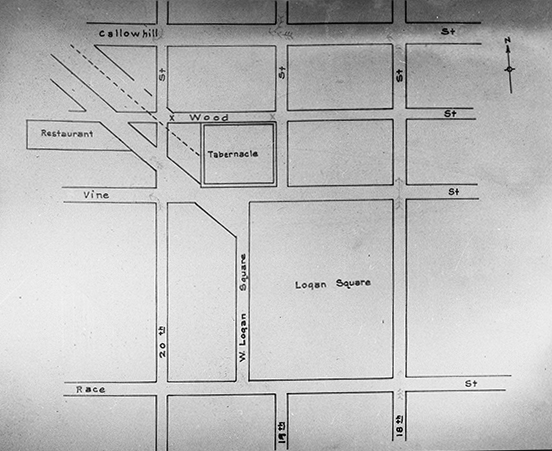
In 1915, Johnson joined other makers and shakers to fund the construction of a giant tabernacle on the north side of Logan Square, where the Free Library now stands. From the inside, this temporary wood and tar paper structure looked like “a miniature forest of timbers.” It seated 20,000 and thousands more would stand in eight spacious aisles that converged at a large open space in front of the podium. The aisles were covered daily with fresh sawdust.
Billy Sunday’s Tabernacle on Logan Square, 1915. (PhillyHistory.org)
Billy Sunday, America’s “greatest high-pressure and mass-conversion” evangelical preacher, operated twice daily in this tabernacle, January into March. In all, more than 1.8 million turned out for Sunday’s 147 sermons. And more than 44,000 found themselves inspired to walk the “Sawdust Trails,” confirming their faith in a handshake with Sunday.
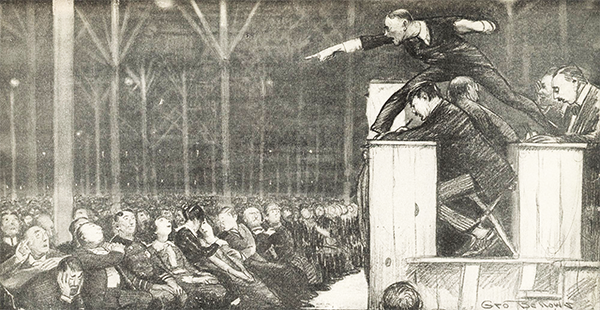
At the front was a 10-foot wooden platform with a small, steel-reinforced pulpit that Sunday would regularly climb to emphasize a point in his sermon. Sunday had played professional baseball before ending his athletic career in Philadelphia in the early 1890s and his continued athleticism marked him as “the acrobatic dervish of evangelism.” His traveling entourage always included a trainer.
Hours before the start of each service, hawkers fanned out for blocks, barking “Git yer hymn-book here! Git yer only authorized life of Billy Sunday!” As packed trolley cars approached 19th and Vine, conductors announced: “Backsliders get out here.” One visitor compared the atmosphere to that of a circus.
Inside, a choir of 1,800 voices started with “Stand Up For Jesus” followed by “Brighten the Corner Where You Are.” Then Sunday walked on stage, charmed the audience, and launched into an animated sermon against the evils of a modern, open society, the “whiskey kings, the German warlords, slackers, suffragettes or the local ministry.”
“He begins to dance like a shadow boxer,” observed journalist John Reed. “He slaps his hands together with a report like a broken electric lamp. He poses on one foot like a fastball pitcher winding up. He jumps up on a chair. In the stress of his routine he may stand with one foot in the chair and another on the lectern.”
Evangelist Billy Sunday preaching on March 15, 1915 in a temporary tabernacle erected on the site of the Central Library of the Free Library of Philadelphia . George Bellows for Metropolitan magazine, May 1915. (Free Library of Philadelphia)
“Sunday’s whole sermonizing scheme is worked out to science,” reported ThePublic Ledger. “He half hypnotizes his congregation with his booming demonic roars, which reached the furthest corner of the squat-roofed structure.”
“‘Come on,’ he shouts. ‘Come on, now.'” “Say ‘Yes’ to God. That’s all. He wants you; you want him! You’re going to hell! Come on, come on to him! Don’t sit there like fools. Hurry up! Come!!!”
Then the choirmaster started “an old time hymn, plaintive and soft, and a woman, sobbing, wavers down the aisle.”
“Are you coming?” yells Sunday, looking right at you or seeming to. “Jesus is here.” “And then the rush begins and finishes in a near fight for salvation. It seems so easy to be saved, so absurd to remain wicked. The rough Sunday charm “refers to God, Jesus Christ and the Holy Ghost as if he rooms with them or had just bought them lunch.”
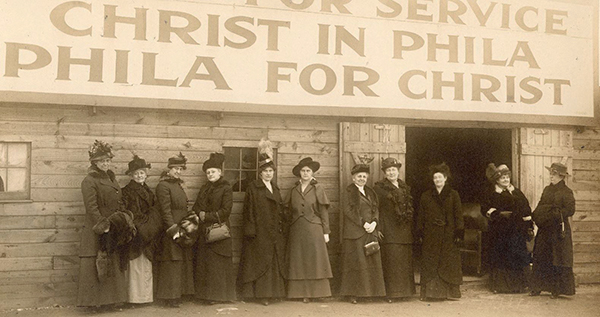
Women gathered under sign reading “Saved for Service Christ in Phila Phila for Christ” at evangelist Billy Sunday’s temporary tabernacle, erected by “Happy” Joe Spiece on the site of the Central Library of the Free Library of Philadelphia (Free Library of Philadelphia)
“He was red in the face now,” noted Reed, “and the sweat was pouring from him” as he climbed onto the pulpit, “sliding from one end of the platform to the other, crouching like a runner, leaping, crouching, every movement as graceful as a wolf’s.”
“He shakes his fist … and cries: ‘Christ is in this city! He has seen every stone laid in Philadelphia. He has heard every lie; seen every false vote; known every vicious thought; every sneer at high and holy things; every yielding to low ideals; Every corrupt practice, every oath, every theft.'”
“Sunday suddenly flung himself across the platform like a baseball player sliding for second.” “‘It’s too late, Philadelphia! . . . It’s too late! Come to Jesus!'”
“Do you know anybody you want to be saved? Stand up! Have you a husband, wife, children, that you would like to see converted?” Throughout the tabernacle they rose by hundreds. “Brother!” they shouted. “Sister!” “My babies! “My husband!”
“God will take you all! “cried Sunday. “Who is coming to Jesus Christ!”
“At the climax,” observed Reed, “the willing and the indifferent hit the ‘Sawdust Trail’ together. The willing came with the merest prompting, fluttering in emotional states of tears of joy, to shake the hands of the evangelist and to sign the convert’s card. The indifferent were usually locked in the arms of one or more herders, experts who discharged their duties in the task of swelling the ranks of those who came forward, whether they signed up or not.”
Sunday described those eleven weeks in Philadelphia as the “Jim-Dandiest” campaign of his preaching career.” Souvenir-seeking followers agreed. As the tabernacle emptied out for the last time, “Men and women pulled down signs from the tabernacle posts and carried them away. They scooped up big handfuls of sawdust from the shadow of the pulpit, filled their pockets and their handkerchiefs with it and carried it home. They took the tin pans which have gathered the tabernacle offerings. They tore the bunting and flags from the rostrum, the flowers from the pulpit; they carried away everything loose that could serve as mementos of the campaign.”
In the weeks after Sunday’s departure, thousands of his converts swelled the church pews of Philadelphia. Ministers of all denominations estimated an increase of as many as 80,000 new members. But would they last? And, more to Alba Johnson’s hope, had Billy Sunday reformed even a single soul? And whatever would become of the idea for “civic reform”?
[Sources: “Find inspiration in “Billy” Sunday: Rev. J. H. Jackson tells of visit to Philadelphia tabernacle,” The Hartford Current, February 15, 1915; “Billy Sunday has preached to nearly 2,000,000 persons in Philadelphia,” The Washington Post, March 9, 1915;”Billy Sunday closes record campaign in Philadelphia,” Chicago Daily Tribune, March 21, 1915 (Originally published in The Public Ledger.); “Billy Sunday saves 41,724; get $51,136.” Chicago Daily Tribune, March 22, 1915; “The end of Billie Sunday’s Philadelphia campaign,” The Sun, March 22, 1915; “Statistics of the Rev. Billy Sunday‘s great campaign in Philadelphia,” The Washington Post, March 23, 1915; “Back of Billy Sunday,” by John Reed. Metropolitan, v. 42, May 1915; “Billy Sunday dies; evangelist was 71”, The New York Times, November 7, 1935.]